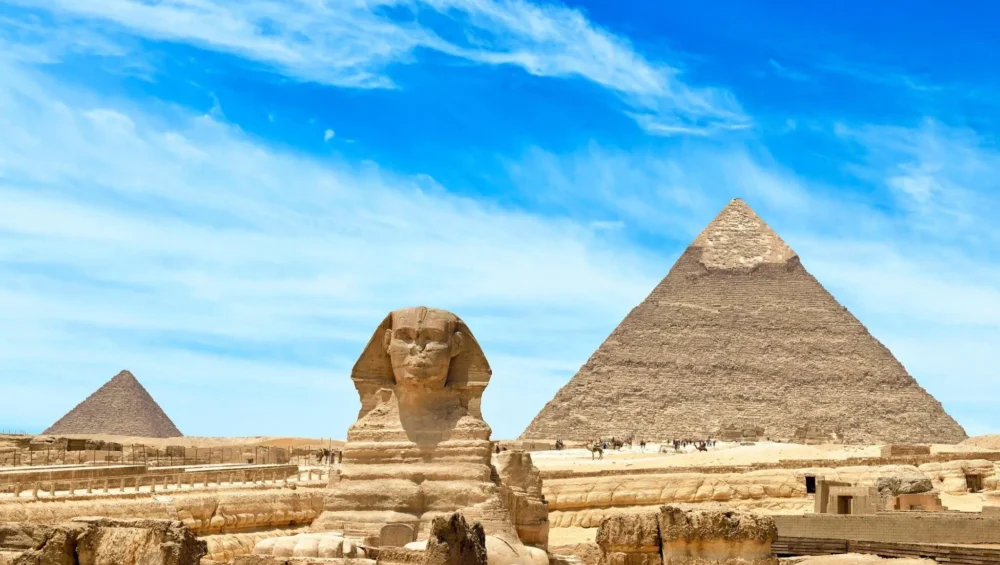
The Giza Pyramids and the Sphinx are two of the most remarkable and renowned structures in the world. Situated on the outskirts of modern-day Cairo, Egypt, they are monuments to the skill and creativity of the ancient Egyptians who built them.
Le Giza Pyramids are a complex of three pyramids, known as the Great Pyramids, which were constructed during the Fourth Dynasty of the Old Kingdom of Egypt. The pyramids were built as tombs for the pharaohs Khufu, Khafre, and Menkaure, and it is believed that they took over 20 years to build. The largest of the pyramids, the Great Pyramid of Khufu, is regarded as one of the Seven Wonders of the Ancient World and was constructed around 2560 BCE.
The Great Pyramid of Khufu
Le Great Pyramid of Khufu is a massive structure standing at a height of 147 meters (481 feet), made up of an estimated 2.3 million stone blocks, each weighing between 2 and 80 tons. The size and complexity of the pyramid have led to speculation about how the ancient Egyptians constructed it. Some theories suggest that they used ramps and pulleys to move the massive stone blocks, while others believe that they may have used water to transport the blocks along specially constructed canals.
Although the other two pyramids, the Pyramid of Khafre and the Pyramid of Menkaure, are slightly smaller than the Great Pyramid of Khufu, they are still impressive feats of engineering. The Pyramid of Khafre stands at a height of 136 meters (446 feet) and was built around 2520 BCE, while the Pyramid of Menkaure stands at a height of 66 meters (215 feet) and was constructed around 2490 BCE.
One of the most intriguing features of the Giza Pyramids is the way in which they were constructed. Each pyramid was built in a series of layers, with the blocks of stone being laid in a precise pattern. The blocks were carefully cut and shaped to fit together perfectly, and the entire structure was then covered in a smooth layer of fine white limestone. This outer layer has mostly eroded over time, leaving only a few remnants, but it is believed that the pyramids would have gleamed brilliantly in the sun when they were first constructed.
Le Sphinx
The Sphinx, located a short distance from the Giza Pyramids, is another iconic structure. The Sphinx is a massive statue that stands 20 meters (66 feet) tall and 73 meters (240 feet) long. It is believed to have been built during the reign of the pharaoh Khafre, who also constructed the second largest pyramid at Giza.
The Sphinx has the body of a lion and the head of a human, and it is thought to represent the pharaoh himself. The statue is carved out of a single block of limestone and is one of the largest monolithic statues in the world. It is also one of the oldest, with some estimates suggesting that it may have been built as early as 2500 BCE.
The Sphinx has been weathered over time, and the original paint on the statue has mostly worn away. The head of the Sphinx has also been heavily damaged, possibly due to erosion caused by wind and sand over thousands of years. Nonetheless, the Sphinx remains a striking and impressive sight.
Researches about the Pyramids
The Giza Pyramids and the Sphinx have captured the imaginations of people around the world for centuries. They are a testament to the skill and ingenuity of the ancient Egyptians and continue to inspire awe and wonder in those who visit them today.
In recent years, research has provided new insights into the construction of the pyramids and the Sphinx. For example, scientists believe that the blocks of stone used to build the pyramids may have been transported from quarries located as far away as Aswan, over 800 kilometers (500 miles) to the south.
Research has also focused on the precise construction techniques used to build the pyramids. Some scientists believe that the ancient Egyptians used a system of counterweights to lift the massive stone blocks into place, which would have required an incredible amount of planning, organization, and understanding of mathematics and physics.
Conclusion
Despite the many unanswered questions surrounding the Giza Pyramids and the Sphinx, they remain among the most impressive and awe-inspiring structures in the world. They stand as a testament to the power and sophistication of the ancient Egyptian civilization and continue to captivate and inspire people from all walks of life. Visiting these iconic structures provides an opportunity to experience the marvels of human engineering and the enduring legacy of one of the world’s greatest ancient civilizations.