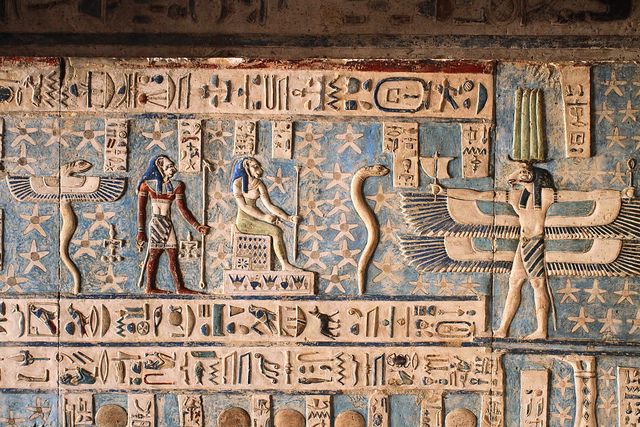
Dendera is a small city situated on the west bank of the Nile River in Egypt’s Qena Governorate. The city is renowned for its ancient temple complex, the Dendera Temple Complex, which is considered one of the best-preserved temples from ancient Egypt. The temple complex is dedicated to Hathor, the goddess of love, beauty, fertility, and music, and is one of the most important places of worship in ancient Egypt.
The Dendera Temple Complex
The Dendera Temple Complex spans an area of approximately 40,000 square meters and comprises various structures, including the Temple of Hathor, the Temple of the Birth of Isis, the Temple of the Sacred Lake, the Mammisi, and other smaller shrines and chapels. The temple complex dates back to the Ptolemaic period and was built over an earlier temple that was destroyed by fire. The construction of the temple complex began in the 2nd century BC and continued over several centuries, with further additions and renovations carried out by subsequent Ptolemaic rulers and Roman emperors.
The Temple of Hathor
The Temple of Hathor is the most significant structure in the complex and is the best-preserved. The temple is situated on a raised platform, and its walls and columns are adorned with intricate reliefs and carvings that depict various scenes from Egyptian mythology. The temple also features several halls, chambers, and sanctuaries, each with its unique architectural and decorative features. The hypostyle hall is the most notable of these chambers, supported by 24 columns, each adorned with images of Hathor.
One of the most striking features of the Temple of Hathor is its astronomical ceiling, considered one of the most significant astronomical representations from ancient Egypt. The ceiling is divided into seven sections, each depicting different astronomical phenomena, including the constellations, planets, and zodiac. The central section of the ceiling features a depiction of the sky goddess Nut, who is shown arching over the earth with her body covered in stars.
Temple of the Birth of Isis
Another notable structure in the Dendera Temple Complex is the Temple of the Birth of Isis, located north of the main temple and dedicated to the goddess Isis, believed to have been born in Dendera. The temple is built in the traditional Egyptian style and features a sanctuary, a hypostyle hall, and a courtyard. The walls of the temple are adorned with reliefs and carvings depicting scenes from the life of Isis, including her birth, her marriage to Osiris, and her role as the mother of Horus.
The Temple of the Sacred Lake
The Temple of the Sacred Lake is another significant structure in the complex and was believed to have been used for ritual purification ceremonies. The temple is built around a large rectangular lake, which was believed to have been the home of Hathor. The temple features several chambers and sanctuaries, each with its unique architectural and decorative features. The walls of the temple are adorned with reliefs and carvings depicting scenes from the life of Hathor, including her role as the goddess of love, music, and fertility.
The Mammisi
La Mammisi is another important structure in the Dendera Temple Complex, located south of the main temple, and built to commemorate the birth of the god Horus. The Mammisi is a small chapel that features a sanctuary, a hypostyle hall, and a courtyard. The walls of the chapel are adorned with reliefs and carvings depicting scenes from the life of Horus, including his birth, his childhood, and his victory over the god Set.
The Dendera Temple Complex also houses several other smaller shrines and chapels, each dedicated to various Egyptian gods and goddesses, including Osiris, Anubis, and Khonsu.
Significance of Dendera Temple Complex
Apart from its historical and cultural significance, the Dendera Temple Complex is an important site for the study of ancient Egyptian religion and astronomy. The astronomical ceiling of the Temple of Hathor, in particular, has attracted the attention of astronomers and Egyptologists for many years and is widely regarded as one of the most important astronomical representations from ancient Egypt.
Despite the challenges faced by the Dendera Temple Complex over the years, including natural disasters, looting, and vandalism, the Egyptian government has taken significant steps towards its preservation and protection, including restoration work and increased security measures. The temple complex is now open to visitors and is a popular tourist destination for people from all over the world.
Conclusione
In conclusion, the Dendera Temple Complex is an impressive ancient temple complex that honors Hathor, the goddess of love, beauty, fertility, and music. The complex comprises several structures, including the Temple of Hathor, the Temple of the Birth of Isis, the Temple of the Sacred Lake, the Mammisi, and smaller shrines and chapels. It is significant for its contributions to the study of ancient Egyptian religion and astronomy, as well as its importance to preserving ancient Egyptian art, culture, and history. Despite its challenges, the temple complex remains a popular tourist destination and serves as a vital cultural resource for future generations.