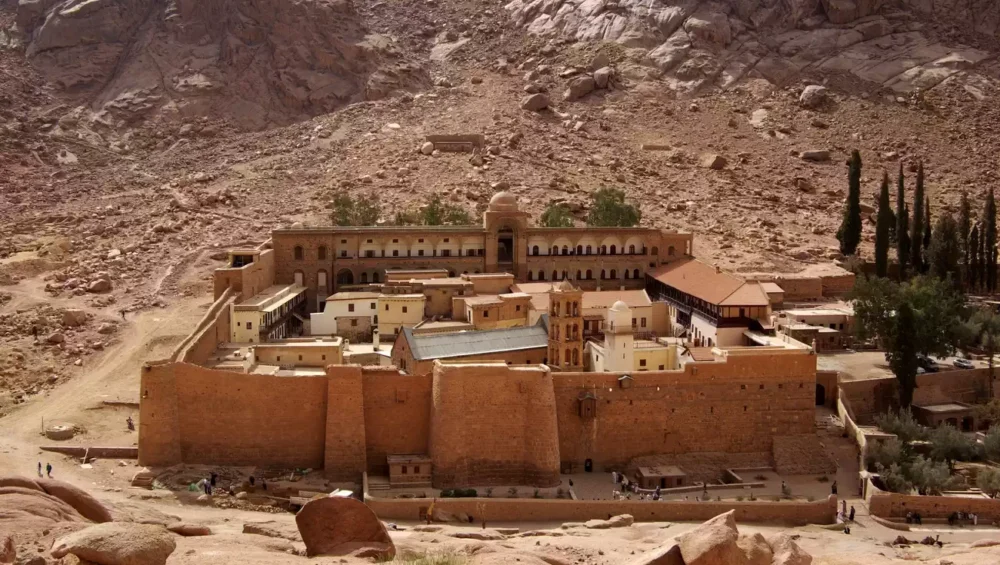
Mount Sinai is a mountain located in the Sinai Peninsula of Egypt that has been considered a holy site for thousands of years. It is believed to be the location where Moses received the Ten Commandments from God and has since become an important pilgrimage site for Christians, Jews, and Muslims. St. Catherine Monastery is situated at the foot of the mountain and is one of the oldest functioning Christian monasteries in the world.
Mount Sinai Significance
The mountain has a long and significant history. It is named after the moon god of the ancient Egyptians, Sin, but it is more famously known as the place of Moses’ encounter with God. The story of Moses receiving the Ten Commandments from God is a pivotal event in the history of Judaism, Christianity, and Islam. According to the biblical account, Moses climbed to the top of the mountain and stayed there for forty days and forty nights, during which he received the tablets containing the Ten Commandments. The mountain is also believed to be the place where Elijah the prophet had a vision of God.
The Burning Bush
Christians have long considered Mount Sinai a pilgrimage site. St. Helena, the mother of Emperor Constantine, visited the region in the 4th century AD and built a chapel at the foot of the mountain. This chapel, known as the Chapel of the Burning Bush, is still standing today and is believed to be the site where Moses first encountered God in the form of a burning bush. Over the centuries, Mount Sinai has witnessed numerous conflicts and battles, including those during the Crusades and Bedouin rebellion. Despite its turbulent history, Mount Sinai has remained a place of pilgrimage and spiritual significance for people of many faiths.
St. Catherine Monastery
St. Catherine Monastery was founded in the 6th century AD by the Byzantine Emperor Justinian I, on the site where St. Catherine of Alexandria was believed to have been buried. The monastery was built to protect the site and monks from Bedouin attacks. Over the centuries, the monastery became an important center for learning and scholarship. The monks at St. Catherine also played a key role in the development of the Eastern Orthodox Church. The monastery has withstood many attacks and disasters over the centuries, including ones from Muslim armies, earthquakes, and Crusader forces. In the 11th century, the monastery was damaged by an earthquake, but was rebuilt by the Byzantine Emperor Michael IV. In the 13th century.
The Spiritual Significance of Mount Sinai and St. Catherine Monastery
Mount Sinai and St. Catherine Monastery hold spiritual significance for Christians, Jews, and Muslims. The mountain represents God’s presence and the place where the Law was given to Moses for Christians, a sacred place in Judaism. The monastery is also revered as a holy site for its connection to St. Catherine of Alexandria, a Christian martyr.
Visiting Mount Sinai and St. Catherine Monastery can be challenging due to its remote location. The most common way to reach it is by taking a bus or taxi from Dahab or Sharm El Sheikh. Visitors should also be prepared for the extreme heat and harsh conditions of the desert. The climb to the top of the mountain is physically demanding, but watching the sunrise over the desert is considered a life-changing experience.
Conclusion
In conclusion, Mount Sinai and St. Catherine Monastery have a rich history and spiritual significance for people of many faiths. They are important pilgrimage sites and can provide a powerful spiritual experience for visitors. The mountain and monastery have played a significant role in the history of the region, and their continued existence is a testament to the enduring power of faith and the human spirit.